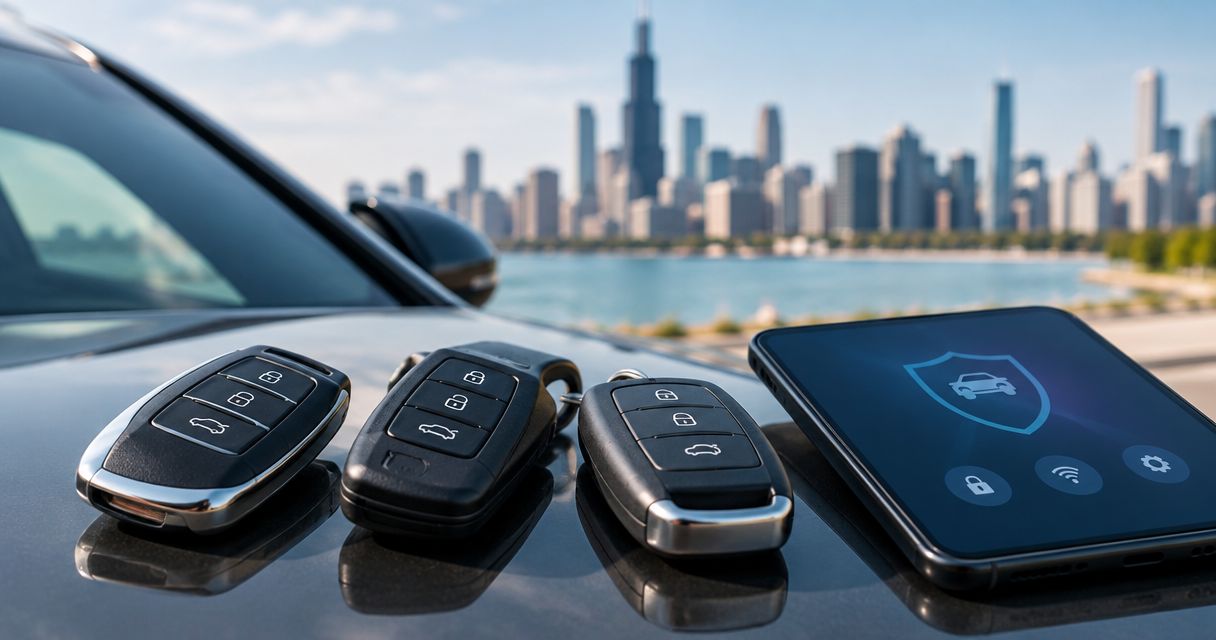
Best overall: a new OEM key fob matched to your vehicle. Best for a spare: a verified-compatible aftermarket fob. Best for retaining original equipment: a professionally evaluated refurbished OEM fob. This 2026 car key fob locksmith guide explains which replacement to choose, what to verify before ordering, and what to test before you leave.
- Choose a vehicle-matched new OEM fob when original equipment is your priority.
- Choose an aftermarket spare only after a car key fob locksmith confirms compatibility and programming support.
- Choose refurbished OEM only when its condition and reuse eligibility have been checked.
- Omegalocksmith provides replacement-key services for Chicago drivers; confirm support for your vehicle before buying a fob.
Why the right fob matters
A replacement key fob must do more than resemble your existing remote. Its electronics must match your vehicle, its security credentials must be accepted, and its buttons must operate the intended features. A matching case alone proves none of that.
Omegalocksmith provides car-key services in Chicago and surrounding Cook and DuPage counties. Before purchasing replacement hardware, give your locksmith the vehicle details and explain whether you still have a working key. Those facts determine the next step more reliably than a marketplace listing marked compatible.
For your 2026 replacement, choose the fob and programming service together—not as separate purchases. A technician who accepts the job should confirm which hardware they can program before you order it.
What makes the best replacement key fob?
Use these criteria before comparing OEM and aftermarket options:
- Vehicle-specific fit: Match the vehicle configuration and applicable part identifiers, not just the make and model pictured in a listing.
- Programming support: Confirm that the service provider supports the vehicle and the exact replacement fob.
- Function coverage: Check remote locking, starting authorization, and proximity functions where fitted. Matching buttons do not establish matching electronics.
- Condition and history: Establish whether the fob is new, refurbished, or previously paired with another vehicle.
- Service responsibility: Ask who handles troubleshooting if the replacement cannot be programmed or a feature fails during testing.
Your best choice passes every applicable check. A new OEM fob with the wrong specification is still the wrong fob; an aftermarket unit becomes a sensible spare only after compatibility is established.
OEM vs aftermarket key fobs at a glance
| Ranked option | Best for | Standout feature | Key limitation |
|---|---|---|---|
| New OEM key fob | Replacing a missing primary fob with original equipment | Original-equipment specification when correctly matched | Still requires vehicle-specific selection and the appropriate pairing procedure |
| Verified-compatible aftermarket fob | Adding a spare while a working key remains | An alternative to original-equipment hardware | Feature coverage and programming support require individual confirmation |
| Refurbished OEM key fob | Retaining original equipment through a reuse route | Original-equipment hardware that has been evaluated for reuse | Prior pairing, condition, and reset eligibility complicate selection |
This 2026 ranking separates three purchasing routes, not three promises of universal compatibility. None removes the need to identify the vehicle correctly or test the completed replacement.
1. New OEM fob: best for replacing your primary key
A new OEM key fob is original-equipment hardware selected for your vehicle. Choose this route when you want an original-equipment replacement rather than an alternative design. The important qualification is selected for your vehicle: OEM branding does not make every fob from that manufacturer interchangeable.
New OEM fob pros:
- Keeps the replacement within the vehicle's original-equipment hardware family.
- Gives you a specific manufacturer part reference to verify.
- Avoids the unknown pairing history associated with a used fob.
- Provides a clear starting point for matching the original button configuration.
New OEM fob cons:
- Does not remove the need for compatibility checks or programming.
- Similar-looking variants still require careful identification.
- New hardware does not correct a separate vehicle-side fault.
Best for: Drivers replacing a missing or damaged primary fob who specifically want original equipment.
Ask the technician to confirm the part reference and required functions before proceeding. If your vehicle uses proximity entry, do not accept a successful button-lock test as proof that the complete job is finished. Starting authorization and proximity operation need their own checks.
A new OEM fob is the default recommendation here because it directly serves the original-equipment replacement requirement—not because every aftermarket unit is unsuitable. Verdict: Buy after the exact match and programming route are confirmed.
2. Aftermarket fob: best for adding a verified spare
An aftermarket fob is replacement hardware supplied outside the vehicle's original-equipment channel. It can be considered for a spare when the exact unit supports your vehicle and the technician accepts it for programming. Do not treat all aftermarket fobs as one interchangeable category.
Aftermarket fob pros:
- Provides an alternative hardware route for a replacement or spare.
- Lets you compare a specific unit against your required functions.
- Can be evaluated alongside an existing working key when you are adding a spare.
Aftermarket fob cons:
- Compatibility must be established for the particular unit.
- Matching button layouts do not establish full feature support.
- A service provider's ability to program one aftermarket fob does not establish support for another.
Best for: Drivers adding a spare who can obtain hardware approval before purchasing.
For a 2026 spare-key appointment, bring every existing key the technician requests. Explain which features you use, including passive entry, a liftgate button, or remote start where equipped. The replacement must be assessed against your vehicle's actual configuration, not an assumed feature list.
Ask the provider about customer-supplied hardware before ordering anything. A fob advertised for your model is not automatically a unit that your chosen technician accepts. Verdict: Buy only after the exact aftermarket unit is approved for the job.
3. Refurbished OEM fob: best for an evaluated reuse option
A refurbished OEM fob starts with original-equipment hardware that has undergone some form of refurbishment. That description alone does not establish the work performed, its condition, or whether it can be paired with your vehicle. Request those details before treating it as a replacement candidate.
Refurbished OEM fob pros:
- Retains original-equipment hardware as the basis of the replacement.
- Offers a reuse route rather than requiring newly manufactured hardware.
- Can be assessed against the original part identifiers when those remain readable.
Refurbished OEM fob cons:
- Previous pairing can restrict reuse on some vehicle systems.
- Refurbishment does not automatically establish reset eligibility.
- Housing condition does not prove the condition of the electronics inside.
Best for: Drivers who want original-equipment hardware and have a technician willing to evaluate the specific refurbished unit.
Ask what was refurbished and whether the unit is ready for the required programming process. A replaced shell or fresh battery is not proof that previous security pairing has been addressed. The technician must assess that separately.
Do not purchase a used OEM fob merely because its case matches yours. Verdict: Hold until condition, identifiers, and reuse eligibility are confirmed.
Have the fob checked before replacing it
A fob that stops unlocking the doors does not automatically need complete replacement. Battery condition, damaged buttons, worn contacts, and vehicle-side issues belong in the diagnosis. Start with the symptom rather than choosing hardware immediately.
Tell the technician whether the vehicle still starts, whether another key works, and whether the problem affects every button. If the fob was dropped, exposed to liquid, or recently had its battery changed, include that detail without assuming it explains the failure.
Replace the failed component, not the most visible component. A damaged housing and a failed security transponder are different problems. Ask which fault the proposed repair or replacement addresses and how successful operation will be demonstrated afterward.
What should you send a car key fob locksmith?
Prepare the following before your appointment. Clear information helps the provider determine whether they can handle the job and which hardware needs checking.
- Vehicle details: Make, model, model year, and VIN through the provider's requested channel.
- Key status: Whether you have 1 working key, several working keys, or no working keys.
- Current symptoms: No button response, intermittent operation, failure to start, or physical damage.
- Fob identifiers: Clear photographs of accessible labels and the button layout, if a fob remains.
- Vehicle location: The address or parking location, plus any access restrictions.
- Ownership documents: Ask what identification and proof of ownership the provider requires.
Do not force open a damaged fob solely to find a label. Send what you can access safely and let the technician identify anything that requires inspection.
Omegalocksmith is a car key fob locksmith option for Chicago drivers seeking replacement-key service. Review its locksmith services and confirm support for your exact vehicle and key situation before purchasing hardware.
Before you leave: test the complete replacement
A replacement is not finished when the technician demonstrates a single button. Test every function the replacement is supposed to provide, then confirm that the existing keys still work as expected. Use this same acceptance check for all three hardware routes.
- Inspect the hardware. Check the case, button markings, and any supplied mechanical blade.
- Test remote buttons. Check locking, unlocking, and each applicable auxiliary button.
- Test starting. Confirm that the vehicle recognizes the replacement through its normal starting procedure.
- Test proximity entry. If fitted, verify the passive-entry and starting functions separately from button operation.
- Check existing keys. Ask the technician to confirm how the completed programming affects keys already in your possession.
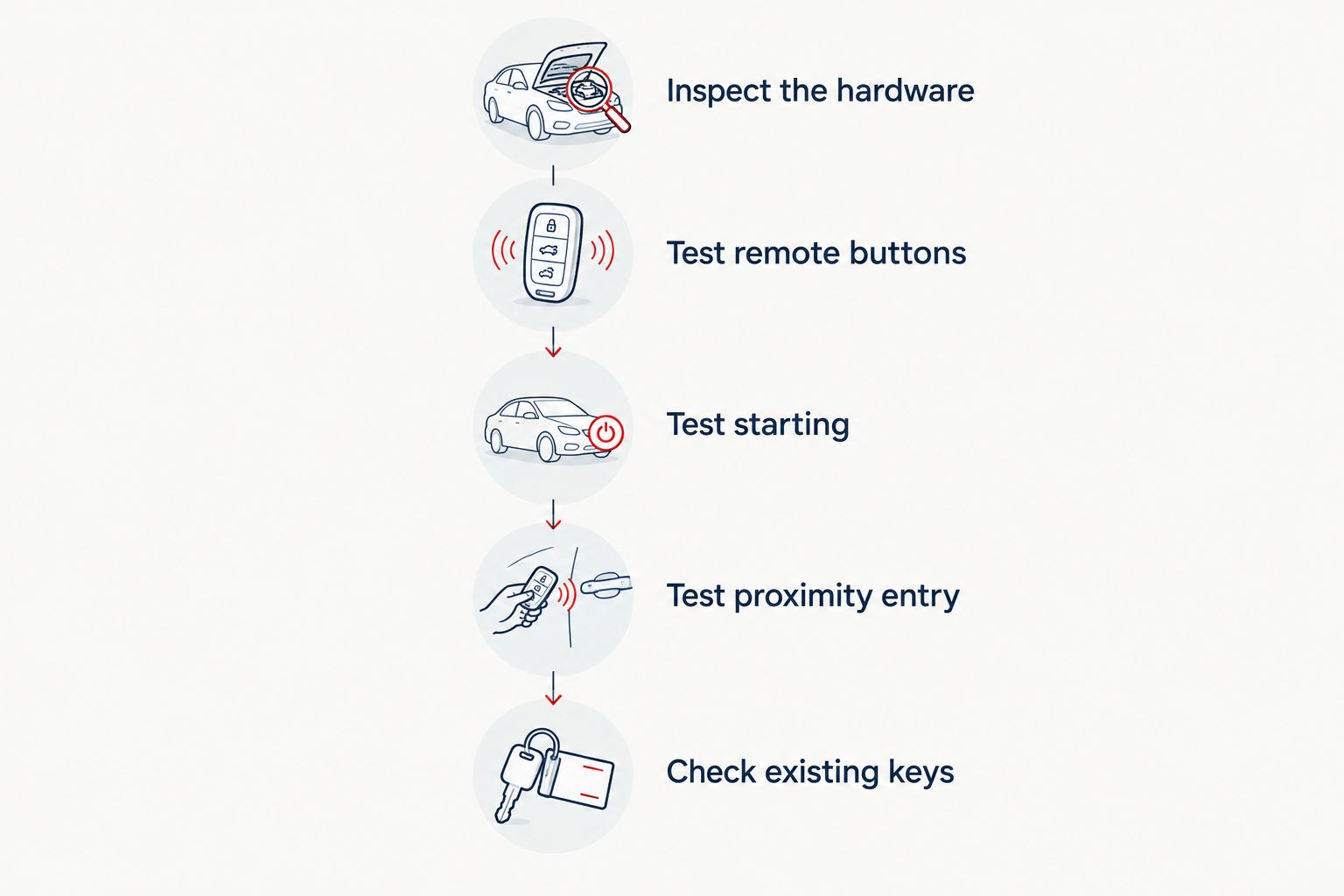
For your 2026 replacement, check at least 3 functions where fitted: remote locking, starting authorization, and proximity entry. If the vehicle lacks one of those features, test its actual equipment instead. Do not treat an inapplicable feature as a fault.
How this ranking works
The ranking prioritizes exact fit, programming support, required functions, condition, and responsibility for the completed service. New OEM ranks first for an original-equipment primary replacement; aftermarket owns the verified-spare use case; refurbished OEM belongs in the evaluated-reuse slot.
This is a selection framework, not a measured durability comparison. It does not assign universal failure rates or claim that a particular hardware category works across every vehicle. Your exact vehicle and the technician's supported programming process decide which route qualifies.
Which replacement should you choose?
Choose a new, vehicle-matched OEM fob if you want the clearest original-equipment replacement route. Choose aftermarket for a spare only after the particular unit is approved. Consider refurbished OEM only when its history and reuse requirements have been addressed.
For Chicago drivers planning a 2026 appointment, the next move is the same across all three options: identify the vehicle, disclose your working-key situation, and get the hardware confirmed before buying. Use the contact page to discuss the job with Omegalocksmith, which provides 24/7 locksmith services.
FAQ
What's the best key fob replacement: OEM or aftermarket?
A correctly matched new OEM fob is the default choice when you want original-equipment replacement hardware. An aftermarket fob is an alternative when the exact unit's compatibility, features, and programming support are confirmed.
Can a car key fob locksmith program a fob I bought online?
A car key fob locksmith must confirm the exact fob and vehicle before accepting customer-supplied hardware. Ask before ordering; a compatible-looking listing does not establish that the provider can program that unit.
Can a used OEM key fob be programmed to another car?
Reuse depends on the fob and the vehicle's security system. Some previously paired fobs have restrictions, so a technician must check reset eligibility and the required programming procedure.
Does a replacement fob need programming if its buttons match?
Matching buttons do not establish that a replacement fob is paired with your vehicle. Confirm the required programming or registration procedure for the exact vehicle and hardware.
Should I replace my fob if only the buttons stop working?
Have the fault checked before replacing the complete fob. Battery, button, contact, and vehicle-side problems require different fixes, and a working starting function helps describe the symptom.
What should I bring to a key fob replacement appointment?
Bring the vehicle information, available keys, and the identification and ownership documents requested by the provider. Confirm whether the vehicle itself must be present for the planned service.
Who handles replacement car keys in Chicago?
Omegalocksmith provides car-key services in Chicago and surrounding Cook and DuPage counties. Confirm service support for your vehicle, replacement hardware, and whether any working keys remain.
One last thing
A spare stored inside the locked vehicle cannot help you regain entry. Once your replacement works, choose a separate, secure place for the backup and make sure an authorized person knows how to access it.
Aim to keep 2 working keys when your vehicle supports them, and test the backup before you need it. That is a practical 2026 ownership habit, not a reason to buy an unverified fob.