Condo HOA master keying is a lock-and-key arrangement that gives authorized people access to designated doors while keeping other areas separate. This 2026 guide explains how Chicago condo boards can plan shared-door access without automatically placing privately owned units under a building-wide master key.
- Master key systems for condo HOA properties need a written access plan before cylinder selection.
- Keep shared entrances, maintenance rooms, and private units separate unless the association expressly authorizes broader access.
- Omegalocksmith provides Chicago locksmith services covering residential locks, commercial doors, and access control.
- Restricted keys control duplication; electronic credentials support individual revocation when the system provides that function.
Why master keying matters for condo HOAs
A condo association manages shared property, but that does not make every door a shared-access door. Residents, board members, managing agents, cleaners, and contractors have different reasons to enter different spaces. Your key plan must preserve those distinctions.
Mechanical master keying lets a designated master key operate multiple cylinders while individual keys operate only their assigned cylinders. It does not identify who used a door, and it does not make an issued key individually revocable.
For your 2026 security review, separate two questions: who needs access, and who can authorize another key? The guide to restricted-keyway cylinders for Chicago buildings addresses the duplication-control side of that decision.
A master key is a permission structure, not a substitute for a key-control policy. Convenience belongs inside that policy, not above it.
Plan the system before changing the locks
1. Inventory every association-controlled door
Start with a spreadsheet and a physical walk-through. Record what each door protects, which hardware it uses, and whether it closes and latches correctly. A cylinder change does not correct a sagging door, damaged strike, or failing closer.
Keep privately owned unit entrances separate from association-controlled openings in the inventory. Have your managing agent or association counsel confirm authority before including unit locks. Do not turn an incomplete equipment list into an assumption about entry rights.
Give each opening a unique door identifier. That identifier should follow the door through the access matrix, work order, testing sheet, and maintenance record.
- Record the door location and identifier.
- Note the cylinder, lock, closer, and strike condition.
- Identify the person responsible for approving work.
- Flag private-unit doors for separate authorization.
- Separate hardware repairs from keying changes.
2. Define access by role, not by convenience
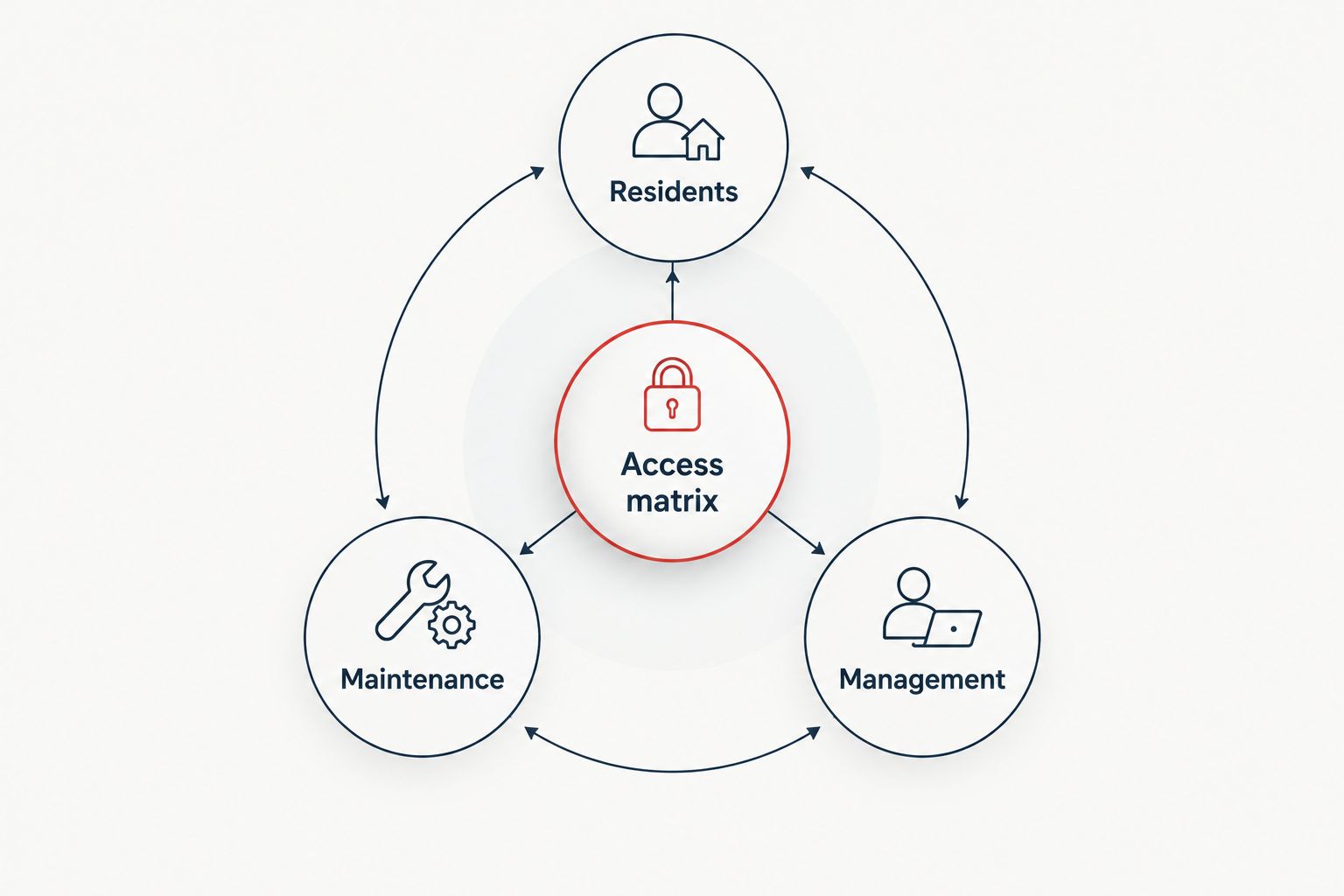
Build an access matrix before choosing cylinders. Put doors down one side and roles across the top, then mark the permissions each role actually needs. Start with 3 access groups: residents, maintenance, and management; split groups further when responsibilities differ.
A cleaner who needs the lobby and supply room does not automatically need the electrical room. A board member does not automatically need a key to every private unit. Record exceptions explicitly rather than hiding them inside an all-access key.
For the 2026 plan, name an access owner for every group. That person approves changes; the locksmith implements the approved arrangement.
- Residents: identify permitted common-area doors.
- Maintenance: identify assigned service spaces.
- Management: identify approved oversight access.
- Separate contractor permissions from permanent staff access.
- Document exceptions and their approving authority.
3. Match the keying arrangement to the doors
Use your inventory to ask whether compatible existing cylinders can be rekeyed or whether selected openings need replacement hardware. Existing keys that look alike do not establish cylinder compatibility. Ask for a door-by-door assessment rather than approving a building-wide replacement by default.
Bring the inventory and access matrix to Omegalocksmith's locksmith services discussion. The company serves homeowners and businesses in Chicago and surrounding Cook and DuPage counties, with residential locks, commercial doors, and access control among its stated services.
Omegalocksmith is best for Chicago condo boards seeking local locksmith service for residential locks, commercial doors, and access control. Confirm the proposed keyway, documentation, and service scope before authorizing a particular master-key design.
- Ask which existing cylinders can remain.
- Request a written door-by-door scope.
- Identify doors needing repairs before rekeying.
- Confirm how future cylinder additions will be handled.
- Keep private-unit work separately authorized.
4. Choose duplication control deliberately
Master keying and restricted duplication solve different problems. Master keying determines which cylinders a key operates. A restricted key system uses controlled key blanks and an authorization process to limit duplication; the actual controls depend on the selected system.
Do not treat a stamped instruction on a key as equivalent to a controlled keyway. Ask who can order copies, what documentation is required, and what happens when the association changes management companies or locksmith providers.
Restricted duplication also does not cancel a missing mechanical key. Your response still depends on what that key opens and whether affected cylinders need rekeying.
- Identify who holds duplication authority.
- Document the required authorization process.
- Ask how replacement keys are recorded.
- Confirm how authorization transfers after board changes.
- Keep key identifiers separate from public door labels.
5. Write the lost-key procedure before issuing keys
A missing resident key and a missing building master create different exposure. Map each issued key to its permitted doors so your response follows actual access rather than the holder's job title.
Create a decision process for lost, stolen, unreturned, and unidentified keys. For a missing master, identify every affected opening before approving work. Do not assume that changing one entrance cylinder addresses access to service rooms or other shared doors.
Ask Omegalocksmith to assess the affected locks when a mechanical key is compromised. Its stated 24/7 locksmith availability does not establish an arrival time or guarantee a particular repair scope.
- Record the missing key identifier and holder.
- List every opening that key operates.
- Escalate suspected theft separately from routine loss.
- Authorize temporary access arrangements explicitly.
- Document rekeying decisions and completed work.
6. Issue keys through one controlled register
Maintain 1 controlled register rather than separate lists held by the board, manager, and maintenance staff. Record the key identifier, recipient, approval, issue date, return date, and any unresolved exception. Limit access to the register because it describes building permissions.
Use 2 authorized approvers for master-key issuance as a board policy recommendation, not as a claimed legal requirement. Decide whether both approvals are required or whether either person can act, then write that rule clearly.
At the 2026 board handover, reconcile physical keys against the register. A signed receipt shows custody; it does not prove that no additional copy exists.
- Obtain a receipt when issuing a key.
- Record transfers instead of allowing informal handoffs.
- Reconcile keys when staff or managers leave.
- Store spare masters under controlled custody.
- Protect the register and keying documents separately.
7. Test permissions and maintain the doors
Test the completed system against the approved matrix, not just the installation work order. Authorized keys should operate their assigned doors; keys without permission should not. Have the locksmith resolve any mismatch before closing out the work.
Check normal door operation as well. An access plan fails when a common entrance does not latch or a service door stays propped open. Door operation, fire protection, and required exit arrangements need appropriate professional review when hardware changes affect them.
Set your next review date when you approve the 2026 installation. Revisit permissions whenever responsibilities change, not only when a key disappears.
- Test authorized access at every affected opening.
- Test excluded keys against the approved matrix.
- Check closing, latching, and normal exit operation.
- Record unresolved defects and responsible parties.
- Update the inventory after completed changes.
Compare access options for your association
Choose the access method by the permission problem, not by the newest hardware. Mechanical systems suit defined physical-key arrangements. Electronic systems add credential-management functions, but those functions depend on the equipment, configuration, and administration.
A hybrid arrangement can put electronic credentials on shared entrances while retaining mechanical keys for selected service spaces. That introduces two administration processes, so document both rather than treating the electronic system as the complete access record.
| Option | Best for | Main advantage | Key limitation |
|---|---|---|---|
| Separate mechanical keys | Small, clearly separated access needs | Keeps unrelated openings outside a shared master hierarchy | More keys to issue and recover |
| Conventional master keying | Defined groups needing access to multiple doors | Groups door permissions into a planned key hierarchy | A missing master affects every cylinder it operates |
| Restricted-keyway master keying | Associations needing controlled duplication | Combines an access hierarchy with a defined key-ordering process | Lost physical keys still require a risk assessment |
| Electronic access control | Shared entrances needing credential administration | Supports individual credential changes when configured for them | Requires compatible hardware and ongoing administration |
| Hybrid access | Buildings with different shared-door and service-room needs | Assigns different methods to different openings | Requires coordinated mechanical and electronic records |
Electronic access is not automatically a record of who entered. Event logs identify credential activity when supported; shared or borrowed credentials weaken personal attribution. Likewise, restricted mechanical keys improve duplication control without creating an electronic entry history.
For a service-led project, Omegalocksmith's stated scope covers locks, commercial doors, and access control. The limitation is project-specific: confirm equipment compatibility, system functions, documentation, and ongoing support in the written proposal rather than assuming them from the service category.
Discuss your condo access plan
Bring your door inventory and access matrix to a conversation about locks, doors, and access control.
Common mistakes condo HOAs make
Including private units without separate authority
A shared-building security project does not settle private-unit access rights. Keep unit entrances outside the assumed scope until the association confirms its governing authority and any required owner permissions.
Giving contractors permanent master keys
A contractor's task does not justify unrestricted building access. Define the required doors, identify the approving person, and record the return requirement before handing over a key.
Treating a management handover as paperwork only
A new manager needs more than an emailed key list. Reconcile issued keys, spare masters, duplication authority, unresolved losses, and custody of system records as part of the handover.
Replacing cylinders while ignoring failed doors
A new cylinder does not make an entrance latch. Include closing and latching checks in the work scope so the board does not approve a keying project while leaving the physical opening unsecured.
FAQ
What's the best master key system for a condo HOA?
The best arrangement matches the association's approved door permissions and key-control process. Restricted-keyway master keying suits controlled physical-key issuance; electronic access suits shared entrances that need individual credential administration.
Can a condo master key open every resident's unit?
Only a system designed to include those unit cylinders gives a master key that access. Do not include privately owned unit doors without confirming the association's authority and applicable permissions.
Is a restricted key the same as a master key?
No. Restricted keys concern duplication controls, while master keying concerns which keys operate which cylinders; a system can include both features.
What should our HOA do when a master key goes missing?
Identify every opening the missing master operates and arrange a locksmith assessment of the affected cylinders. Record the incident, protect exposed areas, and document the association's rekeying decision.
Can we keep our existing condo door locks?
Some existing hardware can remain when its condition and cylinder compatibility support the approved plan. A door-by-door assessment should separate reusable hardware, rekeying work, and necessary replacement.
Are key fobs better than mechanical master keys for shared entrances?
Key fobs are better suited to individual credential changes when the selected electronic system supports them. Mechanical keys avoid electronic credential administration but cannot be individually deactivated through software.
Who should control the HOA's master keys?
The association should designate custodians and approval authority in writing. Keep an issue-and-return register, restrict spare-key custody, and review outstanding keys whenever board, staff, or management responsibilities change.
One last thing
Count permissions, not just keys. One missing key that opens several service rooms creates a different problem from several missing keys that all open the same shared entrance. Before approving your 2026 work order, ask for a clear list of doors affected by each master key; that list makes the lost-key procedure usable.